
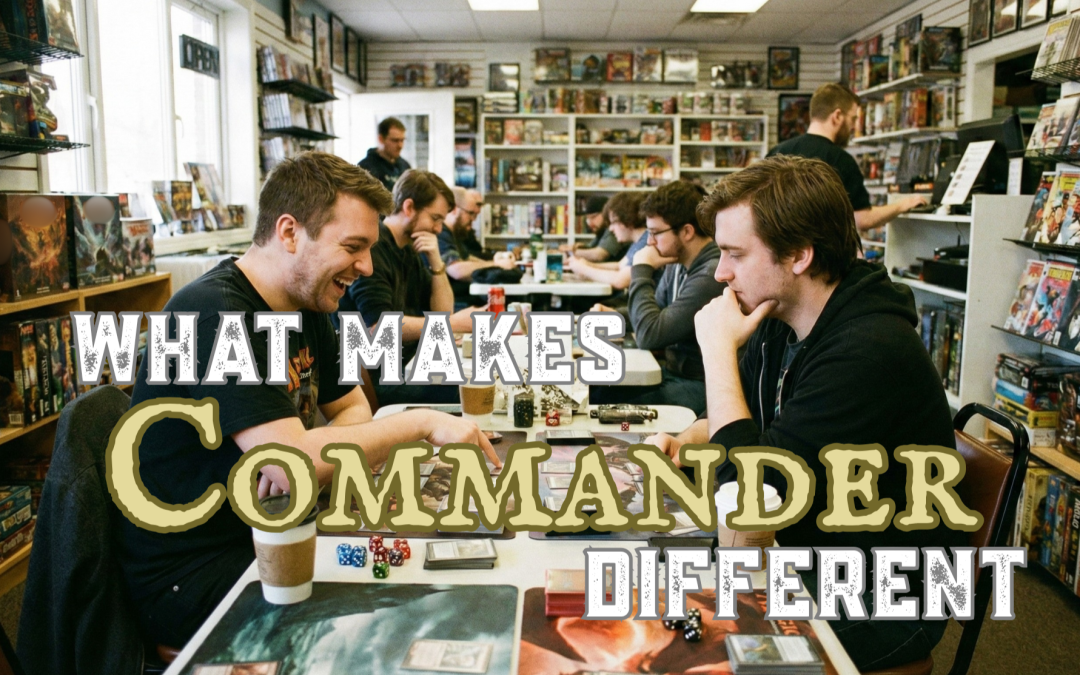
Magic: The Gathering is, at its core, a game about choices. You choose which spells to cast, which creatures to attack with, which threats to answer, and which risks to take. Most versions of Magic present those choices in a controlled, competitive environment: two players, small decks, low life totals, and a clear race to the finish.
Commander is something else entirely.
Commander takes the mechanical foundation of Magic and stretches it outward. Games are larger, slower, louder, and more social. Decks are bigger and less predictable. Victory is no longer just about efficiency, but about timing, perception, and restraint. To someone new to Magic, Commander can feel overwhelming at first, but its differences are exactly what make it one of the most popular ways to play the game.
This lesson explains what truly makes Commander different, not just in terms of rules, but in how those rules change the experience of play.
A Different Kind of Deck
In most Magic formats, decks are built with consistency in mind. You run four copies of your best cards, minimize variance, and aim to execute the same plan every game. Commander deliberately moves in the opposite direction.
A Commander deck contains exactly 100 cards, and with the exception of basic lands, you may only include one copy of any card. This is called the singleton rule. The result is a deck that behaves more like a toolbox than a machine. You are far less likely to draw the same sequence of cards twice, and every game unfolds differently.
This increased variance is not a flaw, it is a design choice. Commander embraces unpredictability. It rewards players who can adapt, pivot, and make the most of imperfect hands. You are not expected to draw your best card every game. Instead, you are expected to understand your deck well enough to find lines of play with whatever you draw.
Because the deck is so large, Commander also allows for a much broader range of card types. Expensive spells that would never see play in faster formats suddenly have room to breathe. A nine-mana sorcery is no longer absurd when games regularly go long enough to cast it.
The Commander Itself
Every Commander deck is built around a single legendary creature, called your commander. This card does not begin the game shuffled into your deck. Instead, it starts in a special zone called the command zone, face up and available to both you and your opponents.
You may cast your commander from the command zone as though it were in your hand. If it dies, is exiled, or otherwise leaves the battlefield, you may choose to return it to the command zone instead of letting it remain where it would normally go.
There is a cost to this privilege. Each time you cast your commander from the command zone after the first time, it costs an additional two generic mana. This is known as the commander tax. The tax increases each time, making it progressively harder to rely on your commander alone.
This dynamic creates one of the most important tensions in Commander deckbuilding: your commander is always available, but it is not disposable. Good Commander decks are built to function even when the commander is removed repeatedly.
The commander also defines your deck’s color identity. Every card in your deck must use only colors that appear in your commander’s mana cost or rules text. If your commander is red and green, your deck may not include white, blue, or black cards at all.
Color identity is more restrictive than it appears, and it shapes every deck at a fundamental level. It forces you to work within a defined slice of the Magic color pie, leaning into strengths and compensating for weaknesses rather than covering everything.
More Players, More Life, More Time
Commander is primarily a multiplayer format, most commonly played with four players in a free-for-all. Instead of trying to defeat one opponent, you must outlast three.
To support longer games, each player begins with 40 life instead of the usual 20. This single rule change has enormous consequences. Aggressive strategies that work well in one-on-one play struggle to deal 120 total life across the table. Games naturally slow down, and early damage matters less than long-term positioning.
Because there are multiple opponents, removal and interaction work differently. In a two-player game, every threat is aimed at you. In Commander, threats are shared. A dangerous creature on one side of the table may be more threatening to another player than to you. Often, the best play is to wait and see if someone else handles it.
This creates a game of patience and observation. Overreacting wastes resources. Underreacting can get you killed. Commander teaches threat assessment in a way no other Magic format does.
Commander Damage and the Shape of Combat
Commander includes a special rule that allows players to lose the game even if they have plenty of life remaining. If a single commander deals 21 or more combat damage to a player over the course of the game, that player loses.
This rule exists to keep combat relevant. Without it, life gain and large life totals could stall games indefinitely. Commander damage ensures that a focused offensive strategy can still win.
Decks that lean into this rule are often referred to as Voltron decks. The term comes from the idea of assembling multiple pieces into a single powerful entity. A Voltron deck stacks equipment, auras, and buffs onto its commander and attempts to eliminate players one at a time through combat.
Cards like Blackblade Reforged, Swiftfoot Boots, and Colossus Hammer are commonly associated with this approach. The strategy is straightforward but risky. If the commander is removed, the deck often stalls.
The presence of commander damage also influences how players evaluate threats. A commander with ten power on the battlefield is far more dangerous than a random ten-power creature, even if both could deal lethal damage over time.
Ready to start your Commander Journey?
Try our premade Commander Proxy Decks
MoxyProxy premade commander decks are ready-to-play Magic: The Gathering EDH/Commander decks built from high-quality proxy cards that stand in for original cards, letting players enjoy fully themed or powerful builds without buying every expensive card. These decks come with 100 cards including a commander and are designed for casual play, testing ideas, or gifting unique custom decks.
Multiplayer Changes Everything
Commander is not simply Magic with more players. The multiplayer environment fundamentally changes how decisions are made.
In a four-player game, you are not expected to win most of the time. Statistically, each player only has a 25 percent chance of victory. That alone changes how players think about success. Commander games are not judged solely by who wins, but by whether the game was interesting, interactive, and memorable.
Politics emerge naturally. Players make deals, whether explicitly or implicitly. You may choose not to attack someone in exchange for protection. You may save removal to answer a shared threat. You may even allow an opponent to live at low life because eliminating them would paint a target on your back.
This political layer does not mean Commander is about manipulation or deception. It is about awareness. Every action you take sends a message to the table. Attacking a player signals aggression. Removing a permanent signals concern. Passing with mana open signals potential interaction.
Understanding how your actions are perceived is as important as understanding what your cards do.
The Social Contract and Rule 0
Commander is governed not only by rules, but by expectations. This is often referred to as the social contract. The idea is simple: everyone at the table is responsible for making the game enjoyable.
Before many Commander games, players have a brief discussion known as a Rule 0 conversation. This conversation happens before the game begins and exists to set expectations. Players may discuss deck power level, play style, or specific cards and strategies.
Rule 0 allows groups to customize their experience. Some tables enjoy fast, highly optimized games with infinite combos and efficient interaction. Others prefer slower, thematic games where everyone gets to cast big spells.
Neither approach is wrong, but mixing them without discussion often leads to frustration.
Certain strategies are particularly sensitive to the social contract. Stax, a term used for decks that restrict resources and prevent normal gameplay, is a common example. Cards like Winter Orb, Static Orb, and Smokestack can effectively lock players out of the game. While these cards are legal, many casual groups find them unfun unless everyone agrees beforehand.
Similarly, infinite combos such as Exquisite Blood combined with Sanguine Bond can end games abruptly. Some groups welcome these interactions, while others prefer games that end through combat or gradual advantage.
Rule 0 does not eliminate competition. It ensures that everyone is competing on the same terms.
Power Is Not the Same as Performance
One of the most surprising lessons for new Commander players is that powerful cards are not always good cards.
In one-on-one Magic, efficiency is everything. Cards like Lightning Bolt are iconic because they provide a lot of impact for very little mana. In Commander, that same card often feels underwhelming. Three damage barely matters when players have 40 life and multiple opponents remain.
Commander rewards impact over efficiency. Cards that affect all opponents or dramatically shift the board state are often stronger than efficient one-for-one trades.
Board wipes like Wrath of God and Blasphemous Act are far more valuable in multiplayer because they can answer multiple threats at once. Large, expensive spells like Insurrection or Rise of the Dark Realms are not just playable, they are game-ending.
This shift also affects deckbuilding philosophy. A card that looks strong in isolation may attract unwanted attention. Cards like Vorinclex, Voice of Hunger or Blightsteel Colossus are undeniably powerful, but playing them often causes the entire table to unite against you.
In Commander, being perceived as the biggest threat can be more dangerous than actually being the biggest threat.
Archetypes and Identity
Commander has its own vocabulary for describing deck styles. Some of the most common terms include:
Battlecruiser, which refers to decks and games focused on large creatures and expensive spells. These games build slowly and end explosively.
Voltron, which focuses on empowering a single creature, usually the commander, to deal lethal damage.
Combo, which seeks to assemble interactions that win the game outright, sometimes infinitely.
Stax, which restricts resources and slows the game to a crawl.
Group Hug, which gives resources to everyone in exchange for political leverage.
These archetypes are not rigid categories. Many decks blend elements from multiple styles. What matters is that your deck has an identity and a plan.
Why Commander Endures
Commander endures because it turns Magic into a shared experience rather than a test of optimization. It values creativity, expression, and adaptability. It allows players to build decks that tell stories, showcase favorite cards, and create moments worth remembering.
For new players, Commander offers a welcoming entry point. You are not expected to master the card pool or play perfectly. You are encouraged to explore, experiment, and learn through play.
Understanding what makes Commander different is the first step toward building better decks and becoming a better player. Not because it teaches you how to win more games, but because it teaches you how to play games that people want to be part of.
In the lessons ahead, we will move from understanding the format to mastering it.